
Climate, Health and Equity Brief
Black rain and global chaos
March 30, 2026
The Climate, Health & Equity Brief is GMMB’s take on the latest news on the current impacts of climate change. If you haven’t subscribed yet, you can do so by clicking here.
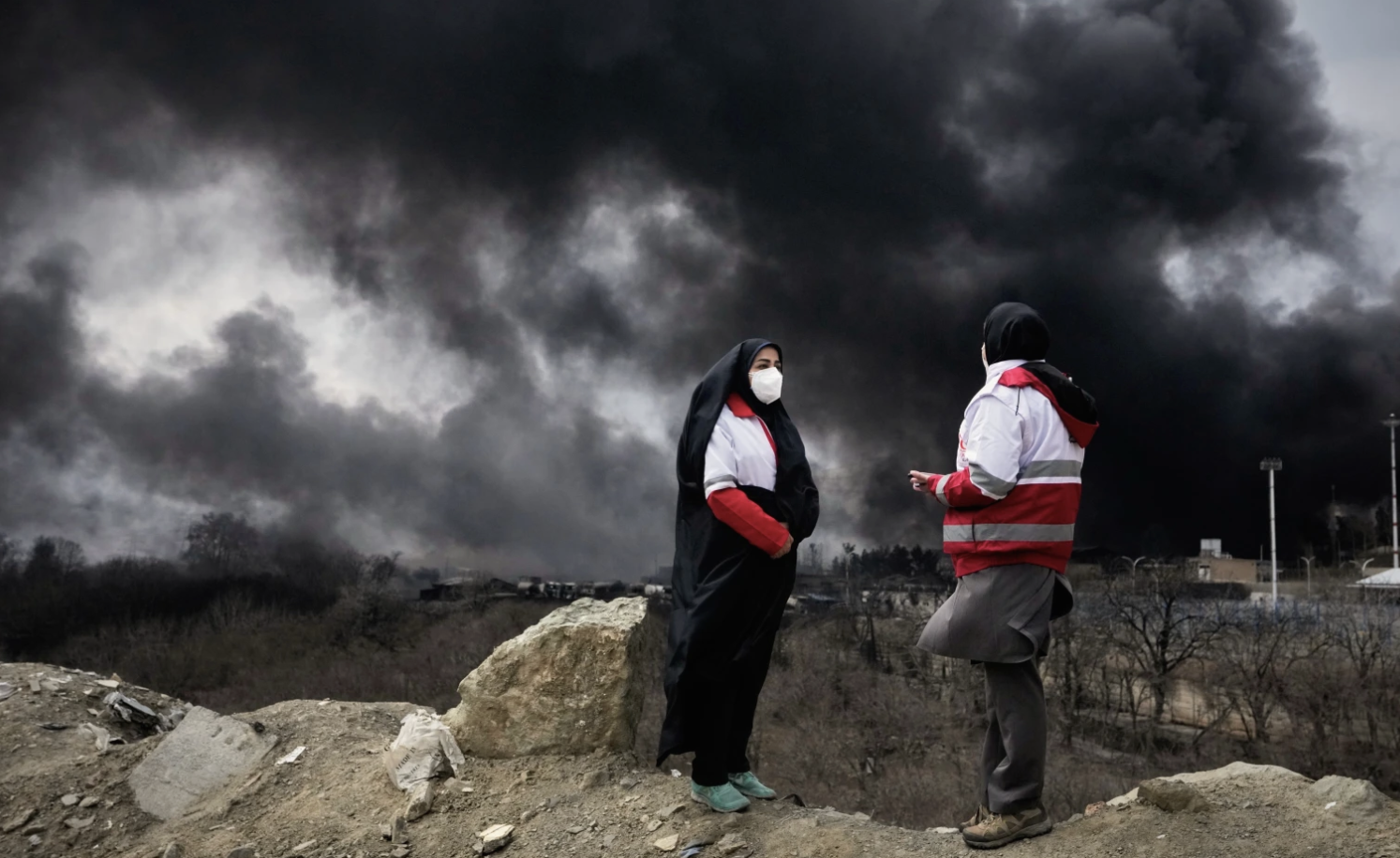
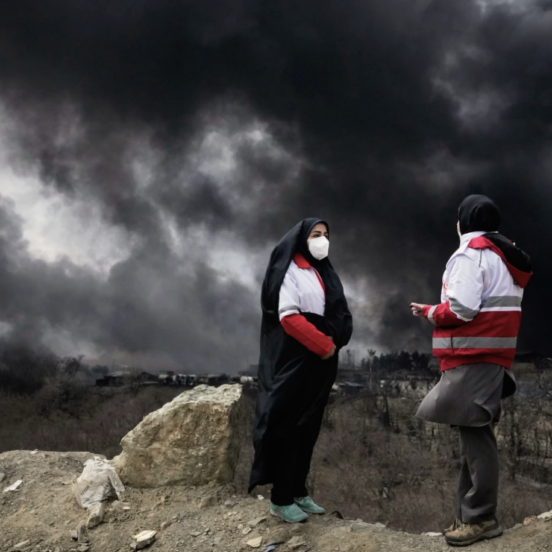
Hot Topic: Shocks.When strikes hit oil facilities around Tehran in early March, black rain—laden with soot, sulfur compounds, heavy metals, and carcinogenic chemicals from burning fuel depots—blanketed parts of the city. Health officials warn that the toxic fallout is contaminating air, soil, and water and could carry long-term health risks to human health.
The war has also delivered a critical lesson about the fragility of the world’s energy system. Iran already suffered blackouts and severe gas shortages; now the strikes on the country’s South Pars gas field—which supplies 70 percent of Iran’s gas—are worsening both and increasing pressure to burn more mazut, a highly polluting fuel oil already associated with severe air pollution in Iran.
With Iran’s closure of the Strait of Hormuz—through which roughly 20 percent of the world’s oil normally flows—the conflict has triggered what the International Energy Agency (IEA) calls the largest supply disruption in global oil market history, sending shockwaves through energy, shipping, and aviation markets worldwide. Cargo has been stranded, shipping costs and war-risk premiums have climbed, import-dependent economies face rising inflation and currency pressure, and airspace closures and security risks have disrupted air travel as jet-fuel benchmarks surge.
This crisis has shown that concentrated fossil-fuel infrastructure is a liability, and when it is disrupted, the global economy pays the price. As the IEA has emphasized, countries investing in renewables, storage, stronger grids, and electrification are better positioned to weather fossil-fuel supply shocks than those dependent on centralized fossil-fuel systems.
Britain’s official climate adviser said this month that reaching net zero would cost less than a single fossil-fuel price shock. China, meanwhile, is investing heavily in renewables to diversify its energy system, even as coal remains central to its power mix. As fuel costs rise and conflict-related disruptions spread through Asia, households and businesses are scrambling for alternatives. In India, war-related liquefied petroleum gas shortages have spurred a rush toward induction cooktops.
Yet even as the war demonstrates this lesson, the U.S. continues to double down on fossil fuels. Just this week, the Trump administration agreed to pay TotalEnergies, a French energy company, nearly $1 billion to abandon two offshore wind leases, and the company said it would redirect that capital into oil and gas projects in the United States.
The war has revealed what climate scientists have long warned: the path to climate stability and energy security is not drilling more oil. It is building more distributed clean energy systems that are harder to weaponize, blockade, or hold hostage to the next geopolitical crisis.
Human Health
A new study found that one-third of the world’s population now lives in areas where extreme heat severely restricts safe outdoor activity, with those living in poorer nations and regions bearing the greatest burden. (The Guardian)
Yet another new study found that rising temperatures are driving physical inactivity globally, projecting that by 2050, heat-induced sedentary behavior could result in up to 520,000 additional deaths and $2.59 billion in annual productivity losses. (The Washington Post)
Planetary Health
A new study has found that most sea-level research has underestimated how high coastal waters already are, and that by century’s end, rising seas could inundate up to 37% more land and threaten tens of millions more people globally. (AP News)
Scientists warn that Earth’s natural systems are losing resilience to absorb further warming as key climate impacts—from intensifying hurricanes to accelerating sea level rise—are now exceeding model predictions. (The New York Times)
Equity
After Mr. Trump’s so-called ‘One Big Beautiful Bill’ clawed back $1.5 billion for tribal renewable energy, tribes across the U.S. are scrambling to keep nearly 1,600 projects alive by turning to philanthropy, alternative lenders, and Native-led financial institutions to fill the gap. (Grist)
The Trump administration is advancing deep-sea mining off American Samoa despite overwhelming local opposition, threatening both the tuna industry and fragile marine ecosystems central to Samoa’s economy and culture. (Inside Climate News)
Scientists warn that the collapse of Antarctica’s rapidly melting Thwaites Glacier would raise sea levels by two feet over several decades, threatening hundreds of millions globally, with adaptation costs vastly beyond reach for developing nations. (The New York Times)
Politics & Economy
Geopolitical turmoil in the Middle East is exposing the vulnerabilities of fossil-fuel–dependent energy systems while strengthening the argument that domestically produced renewable power can improve both climate outcomes and national energy security (POLITICO, AP News)
As climate lawsuits against oil companies mount, Republican lawmakers in Congress and at least five states are pushing bills that would grant fossil fuel producers legal immunity from accountability for climate harms. (Inside Climate News)
The explosive growth of energy-hungry AI data centers, typified by Elon Musk’s Colossus facility in Memphis, is pushing the U.S. toward expanded reliance on fossil fuels which threatens to accelerate emissions and local pollution. (The Atlantic)
As electricity demand from AI data centers surges, prominent Trump allies are reversing course and promoting solar power as essential to U.S. competitiveness and affordability, a dramatic shift from Mr. Trump’s denunciation of solar as “the scam of the century.” (The Washington Post)
As Mr. Trump’s oil blockade exacerbates Cuba’s worst energy crisis in decades, the island is accelerating solar equipment imports from China to generate around 10% of its electricity—among the world’s fastest renewable expansions. (The Washington Post)
A new analysis found that Britain can reach net zero by 2050 for less than the cost of one fossil fuel crisis while boosting energy security and health, contradicting opponents’ claims that the transition would devastate the economy. (The Guardian)
Administration Watch:
- The Trump administration is paying French company TotalEnergies nearly $1 billion to abandon plans to build wind farms on the U.S. East Coast. (The New York Times)
- Mr. Trump is dismantling the National Center for Atmospheric Research, transferring climate and extreme weather research to universities and private companies. (The New York Times)
- Mr. Trump is exempting Gulf of Mexico oil and gas projects from the Endangered Species Act, citing national security concerns. (AP News)
- Mr. Trump invoked the Defense Production Act to restart a Santa Barbara oil pipeline closed since a 2015 spill, defying California’s objections and sparking legal battles. (Los Angeles Times)
- The EPA is withdrawing a regional haze rule that has cut sulfur and smog emissions impacting 150+ national parks. (AP News)
- EPA chief Lee Zeldin is headlining a Heartland Institute conference that rejects climate science, alarming scientists concerned that the agency is endorsing climate-denial fringe theories. (The New York Times)
Action
After the Trump administration deleted USDA climate webpages, a lawsuit forced the agency to publicly share the underlying climate risk data, protecting farmers’ access even if the pages get removed again. (Grist)
A federal judge blocked the Trump administration’s attempt to end New York City’s congestion pricing program, preserving a toll that has reduced traffic by about 27 million vehicles and raised more than $560 million for transit. (The New York Times)
In one of the largest legal challenges yet to Trump’s climate rollback, 24 states have sued to restore the EPA’s endangerment finding, the legal basis for regulating greenhouse gas emissions. (The New York Times)
The European Commission is investing more than €103 million in seven projects across Europe to support climate resilience, ecosystem restoration, and circular-economy goals under its LIFE environmental program. (Mirage News)
Corporate giants, including Google, Amazon, and JPMorgan Chase, pledged $100 million through 2030 to fund projects that cut climate super pollutants like methane, which are responsible for roughly half of all climate warming to date. (Axios)
Life as We Know It
New research has found that climate change is synchronizing wildfire seasons globally, threatening the firefighting resource-sharing arrangements that allow countries to help each other during emergencies. (The New York Times)
Energy analysts warn that the war in Iran could raise U.S. utility bills by disrupting global natural gas supplies and driving up prices, which would affect electricity costs, since about 40% of U.S. power generation relies on gas. (Inside Climate News)
Multiple studies show that clear-air turbulence has increased up to 55% over the North Atlantic since 1979, with projections of increases up to 170% by mid-century if emissions continue. (The New Yorker)
Even as global temperatures soar, media coverage of climate change has fallen 38% since 2021, squeezed out by political turmoil, competing crises, and shrinking newsrooms. (Grist)
Drought and heat in Washington state’s hop-growing region—which produces 75% of the nation’s hops—are threatening US beer supplies, spurring brewers to develop climate-resilient alternatives. (The Guardian)
Kicker
A new analysis unpacks how the Iran war is rattling global energy markets, and why it could either stall or supercharge the clean energy transition. (Carbon Brief)
“The Iran war exposes the fragility of a world that’s dependent on fossil fuels.”
-Energy and climate journalist Antonia Juhasz
The GMMB Climate, Health & Equity Brief would not be possible without the contributions of the larger GMMB team—Catherine Ahmad, Stefana Hendronetto, Nikki Melamed, Kenzie Perrow, Krishna Rajpara, and Marci Welford. Feedback on the Brief is welcome and encouraged and should be sent to [email protected].